
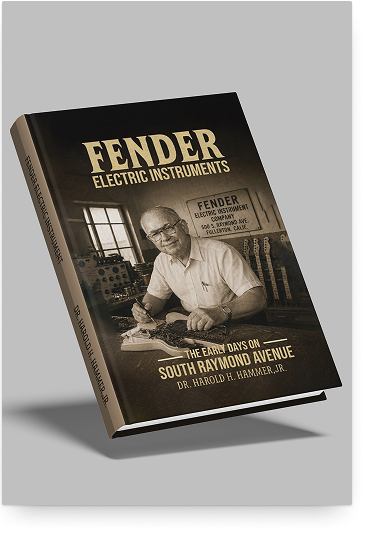
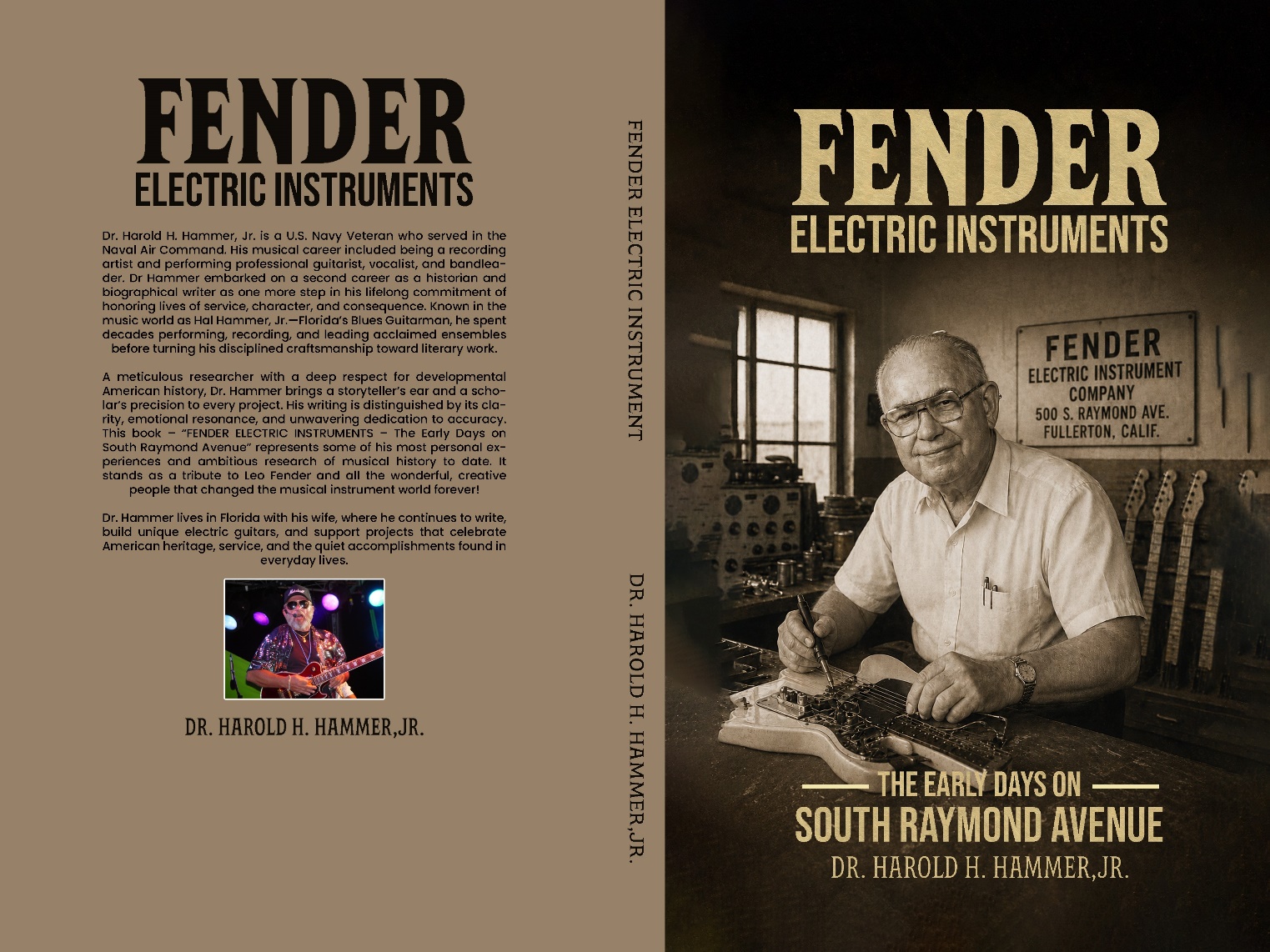
FENDER – THE EARLY YEARS
By Dr. Harold H. Hammer, Jr.
My own connection to this history began not with a guitar, but with a friendship. Ronald Stuart Armstrong was my closest friend, and he was also a dear friend to Leo Fender. Through Ron, I met Leo, spoke with him, and became a fan. I learned about the early days of the South Raymond shop – not as a historian looking back, but as someone listening to the memories of the people who were there. My contributions to this marvelous endeavor were minuscule, compared to all those who actually made Fender the legend it became. I learned so much from Leo, Ron, and all the marvelous, talented people at Fender. It was an experience I truly wish I had been able to fully experience, without the time away demanded by my military service and family responsibilities. Still, I am fortunate, and feel deeply honored that I experienced as much of this magnificent change in musical history as I did. I will treasure the experience, and all that I learned, always!
What I discovered was a world far richer than the familiar legends. The early Fender story is not just about instruments. It is about a small group of craftsmen working in a modest building in Fullerton, California, solving problems one at a time. It is about musicians who tested prototypes late into the night. It is about a quiet, humble man who never learned to play the instruments he built, yet understood them better than anyone.
It is also a story of human vulnerability. Leo’s misdiagnosis . . . . the moment he believed he was dying changed the course of the company and set in motion the sale to CBS. This was not merely a corporate transaction. It was a deeply personal decision made under the weight of fear, responsibility, and love for the people who depended on him.
This book is my attempt to preserve that story . . . . the human story . . . . before it fades into myth. It is built on firsthand accounts, historical research, and the memories of those who lived it. It is written with respect for the people who shaped the golden age of Fender and with gratitude for the friendships that made this work possible.
If you have ever held a Telecaster, a Stratocaster, a Precision Bass, or a Jazz Bass and felt something almost alive in your hands, you have touched the legacy of South Raymond. My hope is that these pages help you understand the people, the place, and the magic behind that feeling.

Clarence Leonidas Fender did not begin his career with any intention of changing the world. In fact, nothing in his early life suggested he would become the most influential figure in the history of the electric guitar. Born in 1909 on a farm near Anaheim, California, Leo grew up surrounded by machinery, tools, and the practical demands of agricultural life. He lost one eye in a youthful accident, but he learned early that if something broke, you fixed it. And if you didn’t know how, you figured it out. This instinct for problem-solving would become the defining trait of his career.
By the late 1930s, Leo had trained as an accountant, a profession that suited his meticulous nature but not his restless curiosity. He spent his days working with ledgers and balance sheets, but his evenings were devoted to tinkering with radios, amplifiers, and electronics. Southern California was alive with music, dance halls, Western swing bands, and small clubs, and musicians constantly needed repairs. Word spread quickly that Leo Fender could fix anything.
In 1938, he opened Fender Radio Service on Harbor Boulevard in Fullerton. The shop was small, but it became a gathering place for musicians, technicians, and curious locals. Leo repaired radios, built PA systems, and designed custom amplifiers for churches and dance bands. He was not yet building guitars, but he was already building relationships with the people who would shape his future.
Musicians trusted him. They brought him their problems — buzzing amplifiers, failing speakers, weak pickups — and Leo listened. He asked questions. He took notes. He studied the way musicians interacted with their equipment. He learned what frustrated them, what limited them, and what they wished their instruments could do.
This was the beginning of Leo’s lifelong habit: designing by listening.
The radio shop also introduced Leo to the world of electric amplification at a time when the technology was still primitive. Hawaiian steel guitars were among the first instruments to use electric pickups, and Leo repaired many of them. He studied their construction, examined their weaknesses, and began to imagine improvements.
By 1943, Leo was building his own amplifiers. They were rugged, loud, and reliable . . . qualities that would later define the Fender brand. Musicians began asking him for more powerful designs, and Leo responded with innovations that pushed the limits of the era’s technology.
It was during these years that Leo met many of the musicians who would later become part of the “Fender Faithful”. . . . the trusted circle of players who tested his prototypes, critiqued his designs, and helped shape the instruments that would define modern music.
The radio shop years were also the period when Leo first crossed paths with men like Doc Kauffman, a former Rickenbacker employee and one of the earliest experimenters in electric guitar design. Their partnership, though short-lived, marked Leo’s first formal step into the world of musical instrument manufacturing.
By 1945, the seeds of the Fender Electric Instrument Company had been planted. The radio shop had become more than a repair business — it was a laboratory, a meeting place, and the birthplace of ideas that would soon transform the musical landscape.
Leo did not yet know it, but the world was about to change. And he was about to change it.
The end of World War II brought a wave of optimism and opportunity to Southern California. Factories that had once produced aircraft parts and military electronics now turned their attention to consumer goods. Returning servicemen filled dance halls, bars, and clubs, and the region’s music scene exploded with new energy. It was in this environment that the seeds of the Fender Electric Instrument Company took root.
By 1946, Leo Fender’s small radio repair shop had become a hub for musicians from across Orange County. They came not only for repairs, but for advice, modifications, and the occasional custom-built amplifier. Leo’s reputation for reliability and innovation spread quickly. He was not a musician, but he listened to musicians with an intensity that made them feel understood. He asked questions, took notes, and studied the way they interacted with their equipment. He was, in many ways, the perfect collaborator: curious, patient, and relentlessly practical.
It was during this period that Leo formed a partnership with Doc Kauffman, a former Rickenbacker employee and one of the earliest experimenters in electric guitar design. Kauffman had worked on some of the first commercially produced electric instruments, and his experience complemented Leo’s technical instincts. Together, they founded K&F Manufacturing, producing lap steel guitars and amplifiers for the booming Western swing market.
The partnership was short-lived. Kauffman, wary of the financial risks of manufacturing, eventually stepped away. But the experience gave Leo something invaluable: a clear vision of what a dedicated electric instrument company could become. In 1946, he reorganized the business under a new name — Fender Electric Instrument Company — and set out to build instruments that were louder, more durable, and more practical than anything on the market.


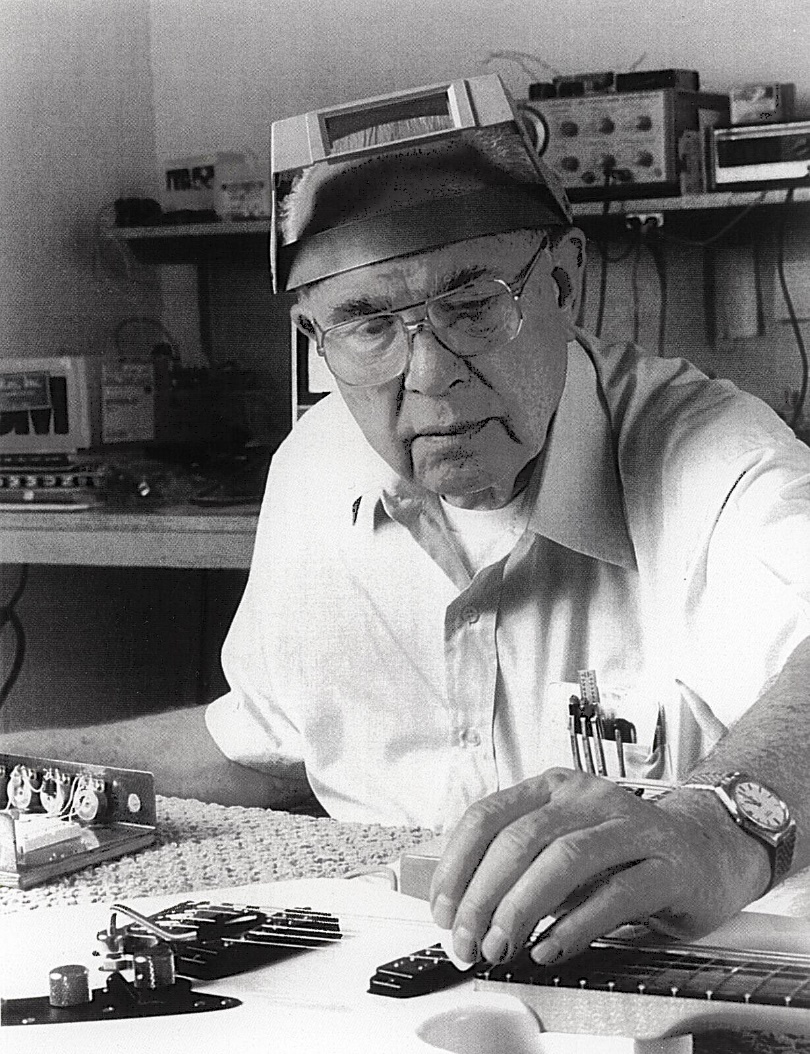
The early years were defined by experimentation. Leo built lap steels with simple, rugged designs that appealed to working musicians. He refined pickup construction, amplifier circuitry, and cabinet design. He learned which components failed under stage conditions and which survived. He learned how to make instruments that could be repaired quickly, often with nothing more than a screwdriver and a soldering iron.
These lessons would shape every instrument Fender produced.
By 1948, Leo had begun to consider a radical idea: a solid-body electric guitar designed not for Hawaiian music or novelty acts, but for mainstream performers. Traditional archtop guitars, even when fitted with pickups, were prone to feedback and inconsistent tone. Musicians complained about fragile hardware, unstable necks, and electronics that failed under the heat of stage lights.
Leo listened. And he began sketching.
The earliest prototypes were crude by later standards — simple pine slabs with bolted-on necks and basic electronics. But they embodied a revolutionary concept: a modular electric guitar, built from interchangeable parts, designed for durability, and optimized for mass production.
This was the beginning of the instrument that would become the Broadcaster, then the Telecaster, and ultimately the foundation of Fender’s identity.
By 1949, the pieces were in place. The South Raymond shop was expanding. New employees were joining the team. Musicians were lining up to test prototypes. And Leo, still working long after the lights were out, was refining the ideas that would soon transform the musical world.
The Fender Electric Instrument Company was no longer just a repair shop. It was becoming a force — one that would soon redefine the sound of American music.
It would become “The Sound Heard Around The World!”
FENDER – THE EARLY YEARS
By Dr. Harold H. Hammer, Jr.
My own connection to this history began not with a guitar, but with a friendship. Ronald Stuart Armstrong was my closest friend, and he was also a dear friend to Leo Fender. Through Ron, I met Leo, spoke with him, and became a fan. I learned about the early days of the South Raymond shop – not as a historian looking back, but as someone listening to the memories of the people who were there. My contributions to this marvelous endeavor were minuscule, compared to all those who actually made Fender the legend it became. I learned so much from Leo, Ron, and all the marvelous, talented people at Fender. It was an experience I truly wish I had been able to fully experience, without the time away demanded by my military service and family responsibilities. Still, I am fortunate, and feel deeply honored that I experienced as much of this magnificent change in musical history as I did. I will treasure the experience, and all that I learned, always!
What I discovered was a world far richer than the familiar legends. The early Fender story is not just about instruments. It is about a small group of craftsmen working in a modest building in Fullerton, California, solving problems one at a time. It is about musicians who tested prototypes late into the night. It is about a quiet, humble man who never learned to play the instruments he built, yet understood them better than anyone.
It is also a story of human vulnerability. Leo’s misdiagnosis . . . . the moment he believed he was dying changed the course of the company and set in motion the sale to CBS. This was not merely a corporate transaction. It was a deeply personal decision made under the weight of fear, responsibility, and love for the people who depended on him.
This book is my attempt to preserve that story . . . . the human story . . . . before it fades into myth. It is built on firsthand accounts, historical research, and the memories of those who lived it. It is written with respect for the people who shaped the golden age of Fender and with gratitude for the friendships that made this work possible.
If you have ever held a Telecaster, a Stratocaster, a Precision Bass, or a Jazz Bass and felt something almost alive in your hands, you have touched the legacy of South Raymond. My hope is that these pages help you understand the people, the place, and the magic behind that feeling.
Clarence Leonidas Fender did not begin his career with any intention of changing the world. In fact, nothing in his early life suggested he would become the most influential figure in the history of the electric guitar. Born in 1909 on a farm near Anaheim, California, Leo grew up surrounded by machinery, tools, and the practical demands of agricultural life. He lost one eye in a youthful accident, but he learned early that if something broke, you fixed it. And if you didn’t know how, you figured it out. This instinct for problem-solving would become the defining trait of his career.
By the late 1930s, Leo had trained as an accountant, a profession that suited his meticulous nature but not his restless curiosity. He spent his days working with ledgers and balance sheets, but his evenings were devoted to tinkering with radios, amplifiers, and electronics. Southern California was alive with music, dance halls, Western swing bands, and small clubs, and musicians constantly needed repairs. Word spread quickly that Leo Fender could fix anything.
In 1938, he opened Fender Radio Service on Harbor Boulevard in Fullerton. The shop was small, but it became a gathering place for musicians, technicians, and curious locals. Leo repaired radios, built PA systems, and designed custom amplifiers for churches and dance bands. He was not yet building guitars, but he was already building relationships with the people who would shape his future.
Musicians trusted him. They brought him their problems — buzzing amplifiers, failing speakers, weak pickups — and Leo listened. He asked questions. He took notes. He studied the way musicians interacted with their equipment. He learned what frustrated them, what limited them, and what they wished their instruments could do.
This was the beginning of Leo’s lifelong habit: designing by listening.
The radio shop also introduced Leo to the world of electric amplification at a time when the technology was still primitive. Hawaiian steel guitars were among the first instruments to use electric pickups, and Leo repaired many of them. He studied their construction, examined their weaknesses, and began to imagine improvements.
By 1943, Leo was building his own amplifiers. They were rugged, loud, and reliable . . . qualities that would later define the Fender brand. Musicians began asking him for more powerful designs, and Leo responded with innovations that pushed the limits of the era’s technology.
It was during these years that Leo met many of the musicians who would later become part of the “Fender Faithful”. . . . the trusted circle of players who tested his prototypes, critiqued his designs, and helped shape the instruments that would define modern music.
The radio shop years were also the period when Leo first crossed paths with men like Doc Kauffman, a former Rickenbacker employee and one of the earliest experimenters in electric guitar design. Their partnership, though short-lived, marked Leo’s first formal step into the world of musical instrument manufacturing.
By 1945, the seeds of the Fender Electric Instrument Company had been planted. The radio shop had become more than a repair business — it was a laboratory, a meeting place, and the birthplace of ideas that would soon transform the musical landscape.
Leo did not yet know it, but the world was about to change. And he was about to change it.
The end of World War II brought a wave of optimism and opportunity to Southern California. Factories that had once produced aircraft parts and military electronics now turned their attention to consumer goods. Returning servicemen filled dance halls, bars, and clubs, and the region’s music scene exploded with new energy. It was in this environment that the seeds of the Fender Electric Instrument Company took root.
By 1946, Leo Fender’s small radio repair shop had become a hub for musicians from across Orange County. They came not only for repairs, but for advice, modifications, and the occasional custom-built amplifier. Leo’s reputation for reliability and innovation spread quickly. He was not a musician, but he listened to musicians with an intensity that made them feel understood. He asked questions, took notes, and studied the way they interacted with their equipment. He was, in many ways, the perfect collaborator: curious, patient, and relentlessly practical.
It was during this period that Leo formed a partnership with Doc Kauffman, a former Rickenbacker employee and one of the earliest experimenters in electric guitar design. Kauffman had worked on some of the first commercially produced electric instruments, and his experience complemented Leo’s technical instincts. Together, they founded K&F Manufacturing, producing lap steel guitars and amplifiers for the booming Western swing market.
The partnership was short-lived. Kauffman, wary of the financial risks of manufacturing, eventually stepped away. But the experience gave Leo something invaluable: a clear vision of what a dedicated electric instrument company could become. In 1946, he reorganized the business under a new name — Fender Electric Instrument Company — and set out to build instruments that were louder, more durable, and more practical than anything on the market.
The early years were defined by experimentation. Leo built lap steels with simple, rugged designs that appealed to working musicians. He refined pickup construction, amplifier circuitry, and cabinet design. He learned which components failed under stage conditions and which survived. He learned how to make instruments that could be repaired quickly, often with nothing more than a screwdriver and a soldering iron.
These lessons would shape every instrument Fender produced.
By 1948, Leo had begun to consider a radical idea: a solid-body electric guitar designed not for Hawaiian music or novelty acts, but for mainstream performers. Traditional archtop guitars, even when fitted with pickups, were prone to feedback and inconsistent tone. Musicians complained about fragile hardware, unstable necks, and electronics that failed under the heat of stage lights.
Leo listened. And he began sketching.
The earliest prototypes were crude by later standards — simple pine slabs with bolted-on necks and basic electronics. But they embodied a revolutionary concept: a modular electric guitar, built from interchangeable parts, designed for durability, and optimized for mass production.
This was the beginning of the instrument that would become the Broadcaster, then the Telecaster, and ultimately the foundation of Fender’s identity.
By 1949, the pieces were in place. The South Raymond shop was expanding. New employees were joining the team. Musicians were lining up to test prototypes. And Leo, still working long after the lights were out, was refining the ideas that would soon transform the musical world.
The Fender Electric Instrument Company was no longer just a repair shop. It was becoming a force — one that would soon redefine the sound of American music.
It would become “The Sound Heard Around The World!”
| Type | Hardcopy, Paperback |
|---|
Reviews
There are no reviews yet